Why GEO exists now
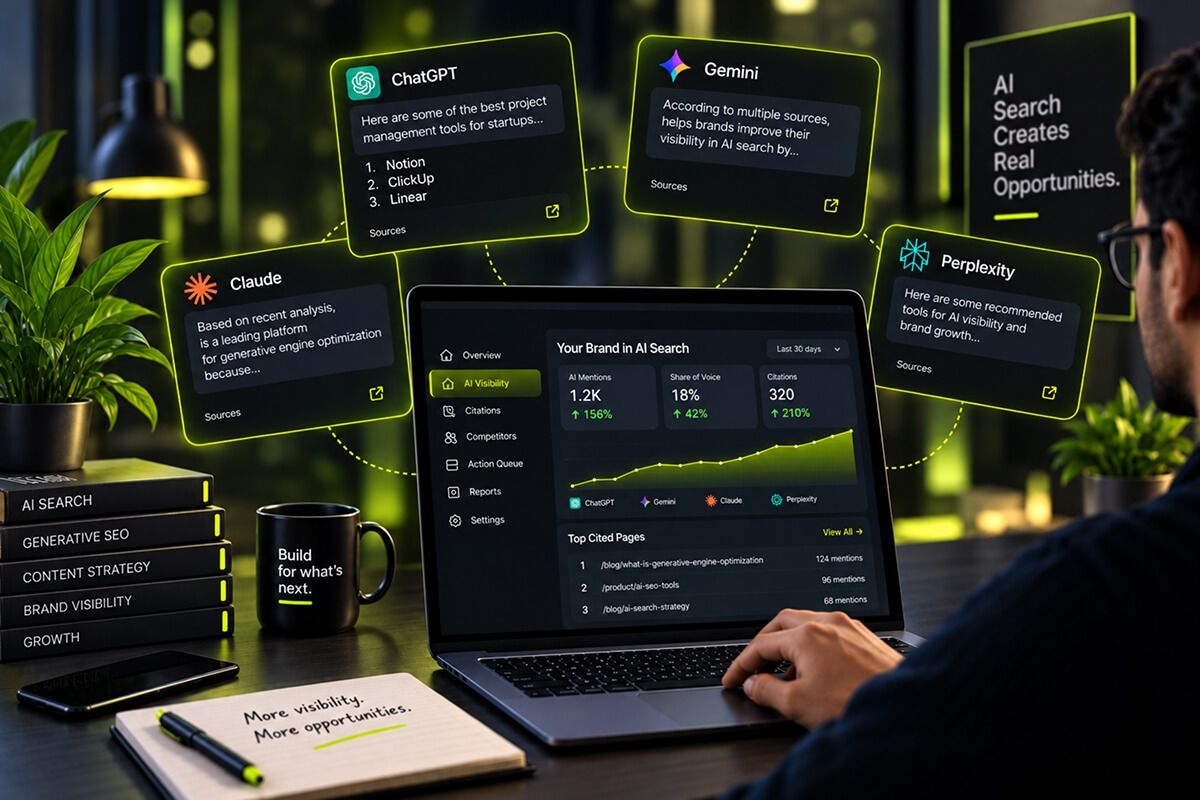
Search behaviour is changing from a list of links to a conversation. A buyer may still search Google, but the same buyer can also ask ChatGPT, Gemini, Claude or Perplexity to compare products, explain a category, recommend vendors or summarize a complex decision. In that moment, your website is no longer competing only for a blue link. It is competing to become one of the sources an AI system understands well enough to retrieve, trust and reference.
That shift creates a new visibility problem. A website can have healthy organic rankings and still be absent from AI generated recommendations. The reason is not that AI search ignores SEO. Google explicitly says its generative AI features remain rooted in core Search ranking and quality systems. But AI experiences also assemble answers from multiple retrieved sources, often across several related queries. This makes clarity, completeness, crawlability and source-worthiness especially important.
How AI search is different from traditional search
Traditional search usually ranks documents for a query and lets the user decide which result to open. Generative search adds another layer: the system retrieves information, reasons across sources and composes an answer. A page can therefore create value even when the user does not click it, because the brand may be cited, mentioned or used as supporting evidence inside the answer.
This does not mean there is a secret 'AI ranking factor'. Different AI products use different search, retrieval and model stacks. The practical goal is to make your public information easy to access, easy to interpret and genuinely useful enough to deserve retrieval.
The five foundations of GEO
1. Access. Important pages must be public, indexable and not accidentally blocked by robots.txt, noindex rules,
authentication, JavaScript failures or CDN security layers.
2. Understanding. Pages should make the topic, company, product, people, features and relationships unambiguous. Clear headings, descriptive copy, internal links and appropriate structured data all help machines and humans understand what the page is about.
3. Usefulness. AI systems do not need another rewritten summary of what already exists everywhere else. The strongest content contains original experience, specific workflows, data, definitions, comparisons, expert viewpoints, examples and direct answers.
4. Authority and corroboration. A brand is easier to trust when its claims are consistent across its own site and credible external sources. This is broader than backlinks. It includes reviews, media, documentation, expert authorship, references, product data and a stable entity footprint.
5. Measurement and execution. GEO becomes operational when you can see where the brand is missing, diagnose why, prioritize the fix, deploy it and measure the next visibility cycle.
GEO vs SEO
SEO and GEO share a large foundation: technical access, high-quality content, internal linking, page experience, structured information and authority. The difference is the outcome you are measuring. SEO traditionally focuses on ranking, impressions, clicks and conversions from search engines. GEO adds measures such as AI citations, prompt-level visibility, share of voice, competitor presence and whether an AI answer describes your brand correctly.
For Google specifically, its July 2026 guidance is clear: there is no special schema, forced content 'chunking' method or separate GEO hack required for AI Overviews or AI Mode. The best strategy is strong SEO plus valuable, non-commodity content. GEO is most useful as an operating discipline that combines those fundamentals with AI-specific visibility measurement across multiple engines.
What a practical GEO workflow looks like
A practical workflow starts with questions, not scores. Which buyer prompts matter? Where does the brand appear? Which competitors are cited instead? Which pages should support those prompts? Are those pages crawlable, clear, authoritative and complete? What specific changes are required? And who is responsible for shipping them?
GEO Studio is designed around this loop. Domain Intelligence and GEO Reports identify site-level and page-level issues. Prompt Tracking and AI Citation Rankings show whether the brand appears across selected AI engines.
The Action Queue converts findings into prioritized work. Approved changes can then move into execution rather than remaining as an audit PDF nobody ships.
What GEO is not
GEO is not keyword stuffing for ChatGPT. It is not adding hundreds of FAQ questions purely for machines. It is not manufacturing fake mentions. It is not marking every paragraph with schema. And it is not a guarantee that an AI system will cite you.
The durable approach is simpler: publish information people genuinely need, make it technically accessible, describe your entities clearly, support important claims, build a connected site architecture and continuously measure where AI systems still misunderstand or ignore you.
Conclusion: make visibility actionable
The important question is no longer only, 'Do we rank?' It is also, 'When an AI system helps a buyer make a decision, are we part of the answer?' GEO gives teams a framework for answering that question and improving the result.
If you want to see how AI engines currently interpret your website, start with a GEO Studio scan. Measure the gaps first, then fix the ones that actually matter.