Why the terminology is confusing
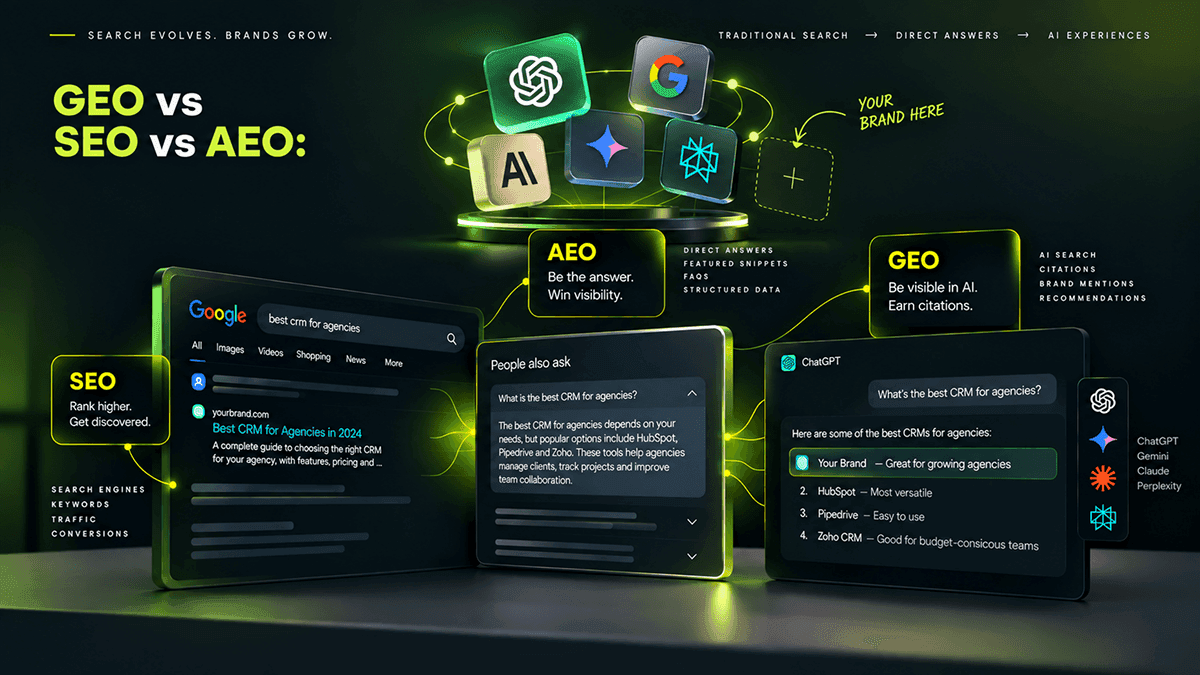
The search industry has created new labels every time the interface changes. Featured snippets produced 'answer engine optimization'. Conversational search accelerated 'generative engine optimization'. The labels are useful when they describe a specific measurement problem, but they become misleading when they imply three unrelated technical stacks.
Google's official position is especially important here. Google says its generative AI search experiences are still rooted in core Search systems and that GEO/AEO should not be treated as a replacement for SEO. That means a technically weak site will not become AI-visible because someone added a new checklist.
What SEO optimizes
SEO is the broad discipline of making a site discoverable, understandable and competitive in search engines. It includes crawling and indexing, site architecture, content, internal linking, structured data, page experience, authority, local and product data, and measurement through tools such as Search Console.
Its common success metrics are impressions, rankings, clicks, conversions and revenue. Those metrics still matter because many AI experiences retrieve information from search indexes and web sources.
What AEO optimizes
AEO is best understood as answer readiness. The objective is to make a page capable of answering a specific question clearly and accurately. That often means direct definitions, question-led headings, concise explanations, comparison tables, steps, FAQs and supporting evidence.
AEO does not require writing robotic 40-word answers everywhere. Google specifically warns against rewriting content purely for AI systems. The useful principle is to make the page easy for a human to navigate and easy for a machine to identify the section that answers the question.
What GEO optimizes
GEO adds a visibility layer for generative systems. Instead of asking only where a page ranks, a GEO program asks: Does our brand appear when buyers ask AI for recommendations? Are we cited? Which sources are cited instead? Are competitors dominating a category prompt? Is our company described accurately? Which site issues correlate with weak visibility?
That measurement changes the workflow. A company may discover that its SEO traffic is healthy but its brand is absent from high-intent comparison prompts. That is a GEO problem even if the fix involves familiar SEO work such as stronger product pages, clearer entities, better internal linking or more authoritative supporting content.
One example: a B2B software brand
Imagine a CRM company that ranks on Google for 'best CRM for agencies' but rarely appears when users ask an AI assistant to recommend CRMs for a 20-person agency. SEO says the page is competitive. GEO says the brand is underrepresented in a new discovery channel.
The solution may involve publishing a genuinely useful agency-specific comparison, clarifying the product's agency use case, strengthening customer evidence, making pricing and features easier to verify, connecting related pages internally, and tracking the exact prompts over time. None of those actions conflicts with SEO. GEO simply gives the team another outcome to optimize.
How to combine SEO, AEO and GEO
Use SEO as the foundation, AEO as a content design principle and GEO as an AI visibility operating layer. First make the site technically sound. Then build useful pages around real user needs. Structure answers clearly.
Finally monitor AI prompts, citations, competitors and visibility so you know where the site is still being overlooked. GEO Studio supports that combined approach by connecting Search Console-informed SEO Analytics with AI visibility, prompt tracking, citation rankings, reports and prioritized actions. The goal is not to create three separate teams. It is to give one growth team a fuller view of how people discover the brand.
Which one does your brand need?
Almost every serious website still needs SEO. Content-heavy sites benefit from answer-ready formatting when it improves usability. Brands whose customers use ChatGPT, Gemini, Claude, Perplexity or Google AI experiences to research purchases should add GEO measurement now.
The practical rule is simple: do not replace SEO with GEO. Extend SEO into the places where search is becoming conversational.